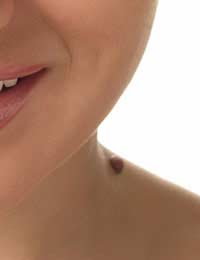
There are four major risks involved when we speak of skin mole treatment and we will look into them now. By the end of this article, we should finally have an understanding of how these risks came about. Thus, in the course of the treatment, we'd know what to avoid and what to do in order to lower those risks. Those are, in other words, ways in which the chances of the respective treatment risks ending up playing out can be reduced. Basically, when we speak of skin mole treatments, we are talking of invasive treatments. Medicine has not yet advanced to a point where you can just pop a pill which subsequently makes your skin moles go away. Treating skin moles thus either involves the excision (cutting) of the moles, or the cauterization of the moles. Both procedures are of an invasive nature. Since they are invasive, there are risks involved when they are employed as treatments.
The first major risk that one can get from any skin mole treatment is the risk of infection. Choosing excision over cauterization, or vice versa, won't matter because both still pose the same risk of infection. But in a procedure that involves pure and simple excision, you'd be at a greater risk of being infected. Infections take place when, during a mole removal procedure where parts of the skin are broken open, pathogens would enter the body. There, they will start what they do: cause diseases. The risk of infection can be reduced by having the procedure carried out under hygienic conditions. These 'minor surgeries' are often taken lightly. But if the medical practitioner undertaking skin mole removal treatment can undertake the procedure with the same seriousness as a major operation, chances of infection can be reduced. The same precautions should be taken, especially when it comes to sterilization of the surgical instruments used as well as prepping the surgical environment. Proper post-operative care can also reduce the chances of infection.
Developing anesthetic allergy is also a risk that is associated heavily with skin mole treatments. Moles are located on the skin at certain depths and, regardless of the depth, there is bound to be some pain involved once they are excised or cauterized. Thus, anesthesia is necessary. However, there are some anesthetic agents that can cause allergies when administered to some people. However, before the procedure, one can't really tell whether the person is allergic or not. That's what makes this risk harder to eliminate or even control.
Skin mole treatments also pose the danger of the person sustaining nerve damage during the procedure. The procedure would have to be conducted with utmost care and caution by the medical practitioner. However, there are times when some nerve formations go out of alignment and lead to nerve damage. This is mostly caused by unique anatomical characteristics of patients.
Probably the one that worries most people, the fourth risk has to do with scars. There is always that risk that, although the mole has been completely removed, it was replaced with an even more unsightly scar. Keep in mind that you'd have lesser options in scar removal than you do in mole removal. What you could do, however, would be to try to hide or mask the presence of these scars using various tricks and tips.
The first major risk that one can get from any skin mole treatment is the risk of infection. Choosing excision over cauterization, or vice versa, won't matter because both still pose the same risk of infection. But in a procedure that involves pure and simple excision, you'd be at a greater risk of being infected. Infections take place when, during a mole removal procedure where parts of the skin are broken open, pathogens would enter the body. There, they will start what they do: cause diseases. The risk of infection can be reduced by having the procedure carried out under hygienic conditions. These 'minor surgeries' are often taken lightly. But if the medical practitioner undertaking skin mole removal treatment can undertake the procedure with the same seriousness as a major operation, chances of infection can be reduced. The same precautions should be taken, especially when it comes to sterilization of the surgical instruments used as well as prepping the surgical environment. Proper post-operative care can also reduce the chances of infection.
Developing anesthetic allergy is also a risk that is associated heavily with skin mole treatments. Moles are located on the skin at certain depths and, regardless of the depth, there is bound to be some pain involved once they are excised or cauterized. Thus, anesthesia is necessary. However, there are some anesthetic agents that can cause allergies when administered to some people. However, before the procedure, one can't really tell whether the person is allergic or not. That's what makes this risk harder to eliminate or even control.
Skin mole treatments also pose the danger of the person sustaining nerve damage during the procedure. The procedure would have to be conducted with utmost care and caution by the medical practitioner. However, there are times when some nerve formations go out of alignment and lead to nerve damage. This is mostly caused by unique anatomical characteristics of patients.
Probably the one that worries most people, the fourth risk has to do with scars. There is always that risk that, although the mole has been completely removed, it was replaced with an even more unsightly scar. Keep in mind that you'd have lesser options in scar removal than you do in mole removal. What you could do, however, would be to try to hide or mask the presence of these scars using various tricks and tips.